
Hidden sugar in foods that look healthy
Yogurt, cereal, juice and plant milk can hold 4 to 11 sugar cubes a serving. USDA numbers for 10 everyday foods and how to spot added sugar.
Ante Vuletić · 2026-10-09 · Updated 2026-10-24
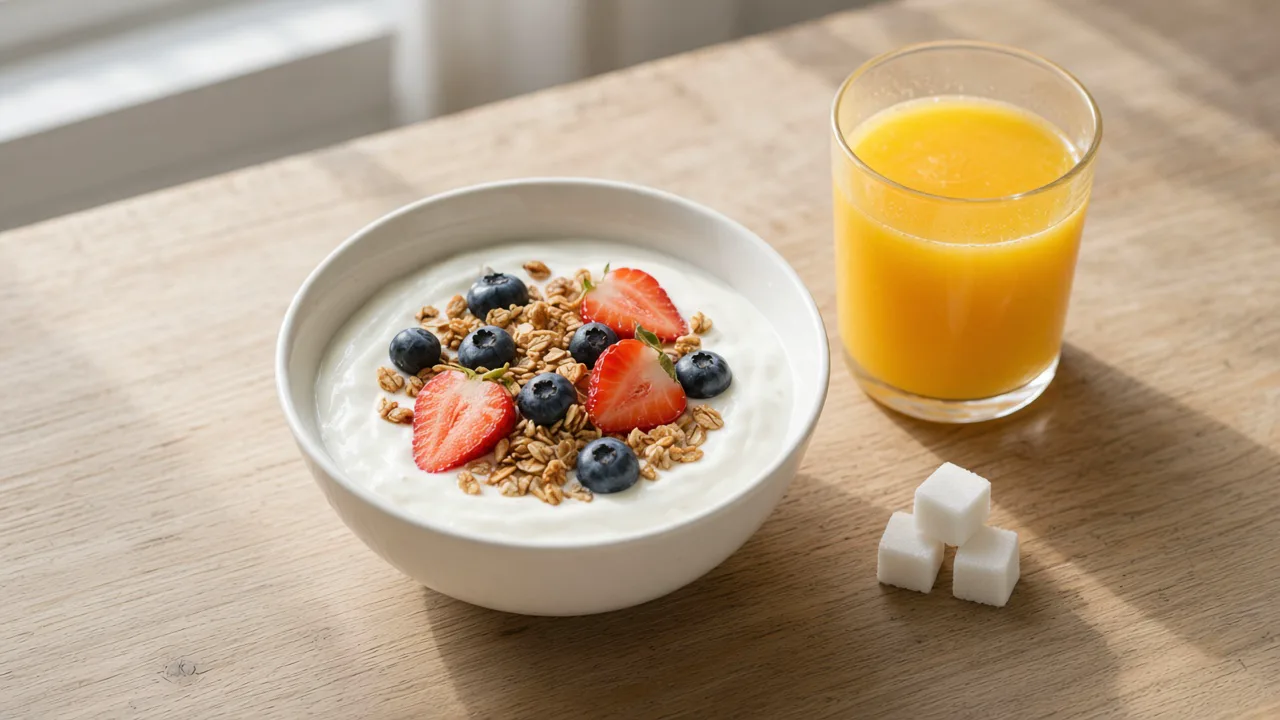
TL;DR: Many foods that look light carry 15 to 45 g of sugar in a normal serving, which is 4 to 11 sugar cubes at 4 g a cube. Some of that is natural milk or fruit sugar and some is added. The Added Sugars line on the label separates them.
Sugar is not a villain. Milk and fruit come with sugar built in. The narrower point is that some foods with a healthy reputation hold as much sugar per serving as a dessert, and the front of the pack rarely says so.
All numbers below are total sugars from USDA FoodData Central (SR Legacy), scaled from the per 100 g value to a typical serving and rounded. One sugar cube is 4 g. Real products vary, so treat them as a reference point and check your own label.
This article is educational. It is not medical advice.
Ten everyday foods in sugar cubes
| Food (serving) | Sugar |
|---|---|
| Smoothie, strawberry-banana with low-fat yogurt (12 fl oz, 347 g) | 44 g sugar, 11 cubes |
| Fruit-flavored low-fat yogurt (6 oz, 170 g) | 32 g sugar, 8 cubes |
| Orange juice drink (1 cup, 249 g) | 23 g sugar, 6 cubes |
| Orange juice, unsweetened (1 cup, 249 g) | 22 g sugar, 5.5 cubes |
| Raisin bran cereal (1 cup, 59 g) | 19 g sugar, 5 cubes |
| Dried apricots (1/4 cup, about 33 g) | 17 g sugar, 4 cubes |
| Sweetened vanilla almond milk (1 cup, 240 g) | 15 g sugar, 4 cubes |
| Granola (1/2 cup, 61 g) | 12 g sugar, 3 cubes |
| Jarred pasta sauce (1/2 cup, 132 g) | 6.5 g sugar, 1.6 cubes |
| French salad dressing (2 tbsp, 32 g) | 5.6 g sugar, 1.4 cubes |
Source: USDA FoodData Central, SR Legacy, total sugars per 100 g, fdc.nal.usda.gov
Drinks and spoonables
Fruit yogurt is the clearest case. Plain whole-milk yogurt in the same 170 g cup has about 8 g of sugar, and all of it is lactose from the milk. The fruit-flavored cup has about 32 g. The roughly 24 g difference is mostly sweetener and fruit preparation. USDA's table gives total sugar only, so that split is an estimate from the comparison, not a measured added-sugar figure.
A 12 oz smoothie made with fruit and low-fat yogurt reaches about 44 g, the highest in this list. Fruit sugar is still sugar once the fruit is blended with more fruit and a sweetened base, and the cup is large enough to drink in a few minutes.
Juice is the one where the label wording matters. Unsweetened orange juice has about 22 g a cup, all from the fruit. An orange juice drink has about 23 g. The totals are close, but the drink includes added sugar and the juice does not. Neither one is the same as eating an orange, which comes with fiber and takes longer to finish.
Plant milks split the same way. USDA lists sweetened vanilla almond milk at about 15 g a cup and unsweetened almond milk at about 2 g. The word vanilla and the word sweetened on the carton are the clue.
Dry goods and pantry items
Raisin bran gives about 19 g in one cup. Part of that is raisin sugar and part is added, and the USDA entry does not separate them. Granola is a similar story at about 12 g in a half cup, and a half cup is easy to double in a bowl. The USDA entry used here is for homemade granola, so a packaged version can differ.
Dried apricots hold about 17 g in a quarter cup. That is natural fruit sugar, concentrated by removing the water. It is a fair snack, and it is also a small handful that looks like very little sugar.
Sauces and dressings use small servings, so the cube count looks modest. Jarred pasta sauce has about 6.5 g in half a cup, and two tablespoons of French dressing has about 5.6 g. They matter most when the serving on your plate is double the serving on the label.
Added sugar or natural sugar?
Natural sugars are the ones in milk (lactose) and fruit (fructose and glucose). Added sugars are the sugars and syrups put in during processing or at the table. The American Heart Association lists sweetened yogurt, fruit drinks, flavored milk, breakfast cereals and bars among the common sources of added sugars.
For a daily ceiling, the American Heart Association suggests no more than 6% of calories from added sugars. That is about 100 calories, or 25 g, for most women and about 150 calories, or 36 g, for most men. The World Health Organization recommends reducing free sugars to less than 10% of total energy intake, and says a further reduction to below 5% would provide additional benefit. Free sugars include added sugars plus the sugars in juice and honey.
Against that ceiling, a single fruit yogurt or orange juice drink can use up most of a day's added sugar budget.
How to spot it
- Read the Added Sugars line under Total Sugars on the Nutrition Facts panel.
- Compare the flavored product with the plain one: plain yogurt, unsweetened plant milk, plain oats.
- Check the ingredient list for syrup, cane sugar, honey, concentrate, and words ending in ose.
- Check the serving size. A granola serving may be much smaller than your bowl.
- Divide grams of sugar by 4 to get cubes.
Log it and see the total
If you already log meals, the sugar in these foods shows up as part of the day's total. Insights, covered in the post on reading your diet score, grades the whole day, and the post on one nutrient not being the whole plate explains why one number alone can mislead. A calorie target also leaves less room for sugar-heavy items, which the calorie deficit post touches on.
A label scan reads the numbers off the pack for you. Signup needs no card and includes 10 free scans.
FAQ
- Is sugar from fruit the same as added sugar?
- No. Fruit and milk sugars are natural. Added sugars are put in during processing. Labels list them separately on the Added Sugars line, and health bodies set limits on added sugars, not on the sugar inside whole fruit.
- Is fruit juice better than a juice drink?
- Unsweetened juice has no added sugar, while a juice drink does. The total sugar in a cup is close for both in the USDA data, so the label wording is what separates them.
- How many grams of sugar is one sugar cube?
- This post counts one cube as 4 g of sugar, about one level teaspoon. Divide grams of sugar by 4 to get cubes.
- How much added sugar is too much in a day?
- The American Heart Association suggests no more than about 25 g for most women and 36 g for most men. The WHO recommends free sugars at less than 10% of total energy, with a further reduction below 5% for additional benefit.
Sources
- USDA FoodData Central, SR Legacy foods: fdc.nal.usda.gov
- American Heart Association, Added Sugars: heart.org
- World Health Organization, Guideline: Sugars intake for adults and children (2015): who.int
Open NutraLog and log your next meal.
Get started free